Posts

On Not Believing In One's Work

For a while now I have been unable (unwilling is what I should say, but from the inside it feels stronger than that) to really commit to doing philosophy research. (I have stuff from before this in the pipeline so it might not be obvious from the outside that I have not been doing new work, but to those who know me this is not news.) The basic issue is that I do not think my work is good or interesting. I have posted about this briefly before but there was an important difference between then and now. The LSE is unusual among British schools in  having something like a tenure institution - there is a review I must pass which, upon being passed, renders it very difficult indeed to fire me, so long as I still do the basics of my job. Since I have now passed this review, the extremely strong instrumental reason I had to publish despite my self-assessment has vanished. As such, where before I thought my work worthless but kept producing it in miserable bad faith, now I can simply foll...
Progressive Liberalism's Dialectic

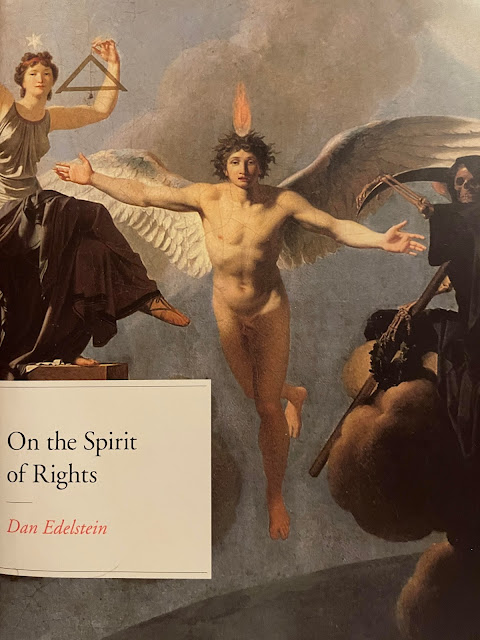
The last thing Condorcet wrote was a long book, entitled Outlines of an historical view of the progress of the human mind . It was published in 1795 and was for a while the most influential thing Condorcet produced (I think nowadays his probabilistic studies of democratic reasoning probably came to overshadow this). It expresses a remarkable optimism about the pattern and inevitability of human progress - an optimism no wise belied by the fact that shortly after its completion Condorcet was arrested and would die under somewhat unclear circumstances a prisoner of the French revolutionary forces, a revolution he himself had supported. It seems he anticipated some such fate, for here is the note on which he ended the piece: "Such are the questions with which we shall terminate the last division of our work. And how admirably calculated is this view of the human race, emancipated from its chains, released alike from the dominion of chance, as well as from that of the enemies of its p...

AI, invertebrates, and the risk of living absurdly

My friend and comrade Jonathan Birch has gifted me with a guest post. I think of it as a kind of belated spiritual sequel to my own musings on the existential status of our profession here . It's a great read, so without further ado over to Birch! -------------------------------------------------------------------------------   Imagine you're the UK Health Secretary during the worst pandemic in a century, signing your name under the most restrictive public health rules in your country's history. You're forced to resign after being caught on CCTV breaking your own guidance—in a manner that also ends your marriage. Feeling your talents may lie more in the area of performing to hidden cameras, you branch out into reality TV. It's going well—people enjoy voting for you to receive grotesque public humiliations—so you decide to write a bestseller about your pandemic experiences. You hire a ghost-writer who is also a noted lockdown sceptic and trust her with 100,000 privat...

The New Alexandria

Here's a little story I tell myself, of very dubious relationship to actual history but through which I understand myself and my own time in philosophy. It's related to the habit (no doubt grounded in some real similarities) people have of describing analytic philosophy as a basically scholastic enterprise. Now, people do not generally mean this as a positive but rather to suggest that analytic philosophy has become (or maybe was from its inception) an exercise in debate for debate's sake, or building castles in the sky. The thought for those who say such things in their most polemical sense is that Scholasticism developed an intricate set of conceptual distinctions and theoretically organised propositions for one to learn, spurred debates about their precise interpretations and interrelations, and... never actually explained anything. Its whole way of approaching the world was divorced from contact with its actual problems, its theories superficial for all their intricacie...

Nothing That Is Not There

Image
Some brief reflections as we approach the new year. I am just returning from a trip to see my partner's family, wherein I spent much time with my little nephew, Kai. There was something entirely fantastic about seeing how, at one years old, he relates to the world. He is so intensely curious about things that seem so mundane. I saw him experience real joy in the triumph of working out how to turn around so as to climb some stairs in a playground. Once at night we went out for a bit of late grocery shopping and it was remarkable how he would seem so engrossed in all the details of an entirely unremarkable street. If philosophy begins in wonder then he's off to a good start.    It caused me to introspect on who I am, or maybe where I am, as a philosopher. People close to me know that I have been on and off convincing myself that I ought stop doing novel research. I am periodically overcome by the conviction that, in some way, what I do or how I do it is making the field worse --...

The Role of Mathematics and Intellectual History in (my) Philosophy

Image
Philosophers tend to think other philosophers are doing bad work and resent their success. I find this tendency most pronounced among mid-to-late stage grad students -- people who are good enough to see the flaws in what's published and aptly feel entitled to critique it as a full fledged member of the community. But who have not yet had the gruelling experience of repeatedly trying to better and realising that you can't, that in fact your work is just fodder for the next batch of sharp eyed youngsters hungry to prove themselves. So it goes, so it goes. One consequence of this is that we all have to get used to justifying our own choice of method or approach to topics. There's always someone out there who thinks its just obvious that you have approached your question in totally the wrong manner, and any non-muddle-head would clearly see that you ought to have... well it just so happens they have a draft manuscript they could share if you are interested. One gets used to fie...

Philosophy, Twitter and Hierarchy

This month's post is a guest post by Mason Westfall . Prompted by a recent essay by Martin Janello  there was recently some discussion on twitter about twitter amongst philosophers. Responding to the general discussion, Mason wrote a very interesting thread on the topic -- I invited him to expand those thoughts into a blog post. I thought the results very interesting, so read on and see what you make of it! ------------------------------------------------------------------------------------------ Twitter promises democratization. When you log on, you can talk to… anyone. Your favorite (and least favorite) journalist is here. You can tell them what you think. Political staffers, novelists, celebrities and comedians are all here, talking. In the real world, it’s a rarity to wind up in the same room as the cultural and political elite. They mostly hang out with each other, and you’re not invited. You have to get lucky, and then maybe you’ll get to mumble ‘I love your work’ or yell ‘F...